Showing posts with label Sunny Murray. Show all posts

Monday, May 4, 2009

Vibrations


My 22-month old daughter has learned how to get a record onto the turntable and start it.  Of course, yesterday she tried to put a cassette tape on the turntable, so she still has plenty to learn.  I have a few old 45’s that are pretty beaten up, so I let her experiment with them.  Once the music starts, she quickly communicates her endorsement or critical disappointment, with the latter typically displayed by a guttural noise akin to a cat trying to hack up a hairball.  I blame her mother.  However, she expresses her approval by doing a strange dance – bending her arms at the elbows, swaying them, and bouncing around.  Again, I blame her mother.  Or at least I’d like to, but I am pretty sure she is doing a pretty spot-on portrayal of her dancing father.  And of course you can't help but dance around the room with her, imitating her dancing style, which likely results in a vicious positive-feedback loop.  But I guess middle-school dances are a long way off.

So far she has given the hair-ball-wretch review to singles by Crosby, Stills, and Nash (who can blame her really?), David Bowie, and Emerson Lake and Palmer.  However, she dances like crazy to Led Zeppelin’s “Black Dog.”  Again, I blame her mother. 

A couple days ago, I put Charles Lloyd’s “Forest Flower” LP on the turntable.  I’ve listened to this album several times after picking it up in the used bin a couple years ago, finding it pleasant but not particularly moving.  However, I stumbled into a really positive review of it recently so I decided to give it another chance.  I was working on other things, so admittedly it didn’t have all of my focus, but I was really surprised at how much I was enjoying it.  I didn’t remember the driving energy and passion of this album!  How did I miss this!  Then the announcer came on at the end of the record, with a voice like Alvin the Chipmunk.  This time, I blame my daughter.  Yes, I played the entire record at 45 rpm instead of 33 rpm, because that is where the setting was left after the last "Black Dog" dancing session.  I listened to a bit more of the Charles Lloyd record at normal speed and it is much less exciting.  If you have a copy of this album, definitely give it a spin at 45 rpm. 

Anyway, I actually have been listening to quite a bit more than bad Crosby, Stills and Nash, vinyl-pop laden takes of “Black Dog,” and hopped-up Charles Lloyd.  Although I haven’t had time to post on this blog for a couple months, I have had plenty of time for free jazz, so that brings me back to Ayler….

In the fall of 2006 I noticed “Vibrations” available for download at the Itunes store for around 6 dollars.  The availability and price surprised me and given that the “money was (still) not strong enough,” for the real thing I purchased the download.  Albert Ayler, Gary Peacock, Sunny Murray, and Don Cherry….six dollars well spent.  Someday I’ll get the CD or the vinyl. 


Albert Ayler, Vibrations

Freedom (among others), 1964

Albert Ayler:  alto and tenor saxophones

Don Cherry:  trumpet

Gary Peacock:  bass

Sunny Murray:  drums


“Vibrations” was recorded in Denmark on September 14, 1964, about two months after “Spiritual Unity” and “New York Eye and Ear Control.”  Don Cherry joins the Spiritual Unity trio and the result is an exhilarating, fast-paced, free-for-all frolic, structured by the repetitive simple melodies so associated with Albert.  At least for me, the emotional feel of the album is not quite as varied as the previous albums of 1964, and I think this is mostly because Don Cherry’s trumpet adds a bright and upbeat quality to the music – even when Albert seems to be taking things to deeper and darker emotional places.  The album is must-have for any Ayler collection, and not a bad place for the uninitiated to begin.  Get it.  Play it.  Maybe even play at 45 rpm.  You can blame me.   

Buy it at Amazon

Sunday, February 1, 2009

New York Eye and Ear Control

The next of my three emusic downloads was "New York Eye and Ear Control," a raucous collective improvisation that is notable for its lack of recurring march-like themes.  For me this album has been a bit difficult to sink my ears into, and I fully anticipated that it would again be difficult to engage with it. Without the occasional structure imposed by the recurrent themes, I have felt a bit like I'm in the middle of Lake Superior, without a raft on an overcast day, trying to figure out which  direction to swim.  However, this week I jumped in, told myself I didn't need a raft or my compass (and yes sometimes I still use a compass), and forced myself to intensively tread water with this thing.  


Albert Ayler, New York Eye and Ear Control
1964, ESP
Albert Ayler:  tenor saxophone
Don Cherry:  trumpet
John Tchicai:  alto saxophone
Roswell Rudd:  trombone
Gary Peacock:  bass
Sunny Murray:  drums

I have been pleasantly surprised by my enjoyment of this album; in fact, it has become increasingly enjoyable with each listen.  Prior to this week, I would have described the album as unstructured cacophony, with little apparent interaction among the musicians, filing it away with other less-than-successful efforts at collective improvisation.  However, upon repeated listening the album has really started to grow on me, and I can't believe that I overlooked how strikingly successful the group interaction really is.  Once I allowed myself to float along, and really become a part of this spontaneous musical landscape, I found myself in awe at how downright amazing these guys really were.  I have discovered this recording for the first time this week.

"New York Eye and Ear Control" was recorded on July 17th, 1964 by Paul Haines for Michael Snow's avant-garde film of the same name.  The gathering took place only a week after "Spiritual Unity" was recorded,  and the same trio is supplemented here by three top-notch and highly creative musicians: Don Cherry, John Tchicai, and Roswell Rudd.  The first track, entitled "Don's Dawn" is only a minute long and features Cherry playing especially smoothly on trumpet with very sparse accompaniment, most prominently Gary Peacock on bass.  A lyrical, short piece, it is quite a contrast to the subsequent two tracks, which are each over 20 minutes long and are comprised of mostly unstructured collective improvisation.  These two longer tracks ebb and flow in intensity, at times are quite spacious, and for the most part Ayler dominants the proceedings.  There are moments when Ayler states what sounds like the fragment or the beginning of a march theme, but each time it is quickly disposed of.  The interaction among the musicians is at times awe inspiring, and this is truly a collective effort.  

Disorienting? Yes.  
Cacophonous? Yes. 
Unstructured?  Yes.  
Spontaneous?  Absolutely. 
Beautiful? At times strikingly so.
Inspiring? Tremendously. 
Do I care which direction I should swim anymore? No.

Below are a couple of relevant audio clips, again taken from the radio show that ESP put together.  The first is Bernard Stollman talking about the album and the participants, and the second is Sunny Murray talking about the album and Albert.


Thursday, January 29, 2009

Spirits Rejoice


My wife and I each had "change jars" before we met, a jar to collect random change and a place to go when you need a couple of quarters for the laundry.  I imagine that most folks have something similar.  After we started shacking up together, we of course merged our jars.  At that point both of our jars represented years and years of collected pennies, nickels, and dimes.  Quarters were notably absent; in fact, the only quarters to be found were Canadian quarters, which often do work for routine American transactions, but of course won't work at the laundromat where the machines are more observant than the average American.  

Anyway, for my birthday in fall 2005 we decided to take the jar to the bank, have them run it through their sorting machine, and spend the money on something fun for my birthday.  Of course "something fun" was "music" to my ears!   To my surprise, all that change actually tallied up to more than $100.  I'd been salivating over the newly released Albert Ayler box set, "Holy Ghost," forcing the folks at Borders to take it from behind their locked glass cabinet on multiple occasions (like most things in Madison, the Borders was much better than they are in other areas, and actually carried a pretty diverse selection of music).  With my 100 dollars from my "piggy bank" I marched in there and asked them to open up that glass cabinet for the last time.  I went home with 10-discs, a book, and the rest of that beautifully packaged box set.

The "Holy Ghost" box set gave me enough Ayler to digest for many months, carrying me through the fall of 2005 and into the late spring of 2006. My five-disc CD player was full of these discs during this time period.  However, I'm not going to review the box set right now.  Since it spans Albert's entire career, and a lot of it is inferior in sound quality to the other releases, it makes the most sense to review it after I have gone through everything else in my collection.

After a cross-country move for a new job, which included the purchase of a house, the "money was not strong enough" (to quote Albert) to continue my Ayler exploration in the same manner as I had in Madison. Although I am not a fan of purchasing MP3 files, because I like the packaging and extra information you get with a CD or vinyl record and I certainly would prefer to have my music in the best fidelity possible, at about this time I saw that emusic carried several Ayler albums, including three that I had not yet heard. At that time emusic was offering 50 free downloads just to join (I think they have now reduced it to 25), and amazingly they allowed you to quit after your free downloads without ever paying anything. Although this seemed really strange and I still feel a little guilty for doing it, it was a way for me listen to these albums that I certainly could not afford at this point in my life.  As the money becomes "stronger" I hope to replace these digital files with the CD release (or track down the vinyl, but most Ayler on vinyl is incredibly pricey).  The first download I listened to was "Spirits Rejoice."


Albert Ayler, Spirits Rejoice
ESP, 1965 (Remastered CD 2006)
Albert Ayler:  tenor saxophone
Don Ayler: trumpet 
Charles Tyler: alto saxophone
Henry Grimes:  bass
Gary Peacock:  bass
Sunny Murray:  drums
Call Cobbs:  harpsichord


"Spirits rejoice" was recorded on September 23, 1965 at Judson Hall in New York. However, it was not a concert recording; instead Judson Hall was rented for this session because of the apparently good or at least interesting acoustics (as discussed by Bernard Stollman in the audio file embedded at the end of this post).  I have to admit, I am not that impressed with the sound quality on the album, although as noted by Bernard it was apparently recorded at twice the usual speed to obtain very high fidelty.  I don't know whether my slight disappointment  with the sound quality is due to the MP3 format, the quality of the particular release that I have, or my own ears.  The album was apparently remastered for the 2006 ESP release, and I have read that the sound quality is quite good on this.  Although the album is relatively similar to "Bells" in feel, not surprising given it was recorded 4 months later and with a very similar group, including Charles Tyler on alto saxophone. However, here Henry Grimes is playing wonderfully free bass and Call Cobbs is featured on harpsicord on the majestic "Angels."  The contributions of these musicians clearly provide a developmental linkage between "Bells" to Albert's 1966 and 1967 work.


The album starts off with the aptly titled title track, which includes some really high-energy and ecstatic free improvisation.  The second track is Holy Family, a short piece with a fast and catchy melody, and this is a pretty straight performance.  In fact, you could play this track for your less Aylery friends and they probably would only raise one eyebrow.  D.C. is a rather chaotic number that jumps pretty quickly into some earth-shattering improvisation; however, late in the piece there is also an imaginative interchange between Murray and Grimes that lasts for about a minute and a half, which serves to dissipate some of the energy before the theme is restated and the piece comes to an end.  This latter segment, with Murray and Grimes engaged in some unconventional talking to each other, has become a real highlight for me on repeated listens.  "Angels" is beautiful, as it is on "Live in Greenwich Village" although the harpsichord is pretty far back in the mix on this album so I find myself cranking the volume way up to really appreciate the track (I'd be interested to hear more about the new ESP remastering of this and whether the harpsichord is brought forward).  The album concludes with a vibrant and screeching rendition of "Prophet."  All in all, this is stuff that will really piss off the neighbors - but for those of us with the acquired ears this is as joyous as music gets.

Below, listen to Bernard Stollman talk about the session.  This clip is from a longer segment focused on Albert Ayler and his music that can be listened to at ESP's web site.


Tuesday, January 27, 2009

Witches and Devils

Eventually I will blog on things less Aylerific.  However, for now I am having a lot of  fun with this project, and I intend to see it through by continuing to work my way through my Ayler collection in the order that I first heard the albums.  Perhaps a more logical approach would have been to review them chronologically, but I don't relate to this body of work in that way and this blog is not meant to be an academic account of these matters, but instead a tool for me to explore my own relationships to this and other music and art.  And besides, we wouldn't want too much structure!  Although I hope that my reviews and thoughts will trigger some people to check this music out, either for the first time or to revisit it with open ears and mind, the primary goal of this blog is personal exploration.  

For each album that I have reviewed so far, I have re-listened to it at least 3 or 4 times.  I have purposely not reacquainted myself with the history of the recording or read any reviews (including re-reading the linear notes of the albums themselves) for the first couple passes through the album.  After that, I have read the readily available reviews, as well as the linear notes of the albums (if available), and then listened to the album a couple more times.  This has been a fantastic experience, forcing me to really "listen" to these recordings - truly feeling them and occupying the space within them.  In addition, writing about these albums has served as an impetus to really grapple with the context and history behind each recording, as well as the personal context and history of my initial and ongoing discovery of this music. 

Like "Bells / Prophecy" I picked up the next album somewhere on State Street in Madison, although it escapes me which particular music shop.  I really liked that town and I miss the culture and intellectual environment - and particularly the great music.  I do remember that I bought this album on a warm day in early fall 2005, and we had a good friend that I had not seen for several years visiting us for the weekend.  After lunch and a few beers on state street, we stopped at the record shop and "Witches and Devils" was on the shelf.  Later that evening, I tried to convince my friend of the virtues of this music.  I don't know if I was successful, although he did end up leaving town with a burned copy of some late-period Coltrane.  He never did tell me his thoughts on it though... of course I can only assume that words alone could not describe its transformative impact.


Albert Ayler, Witches and Devils
Freedom, 1964
Albert Ayler: Tenor saxophone
Norman Howard: Trumpet
Henry Grimes: Bass
Earle Henderson: Bass
Sunny Murray: Drums

"Witches and Devils" (versions of this album were also released as "Spirits") was recorded at Atlantic Studios in New York City on February 24, 1964 - about five months before "Spiritual Unity."  Although Sunny Murray again creates the freeform backdrop for these pieces, the rest of the band is different, with Henry Grimes playing bass on three of the four pieces and Earle Henderson playing bass on two of the pieces. The title track is the highlight of the set for me, probably because it is somewhat different stylistically from the other tracks.  It is a dark, slower paced piece full of mournful solos by Albert, featuring two basses that provide beautiful interaction with Murray's subtle and immensely imaginative drumming, and some equally mournful and heart-wrenching trumpet work by Norman Howard.  The musicians, and particularly the bassists and Murray employ plenty of space throughout, and this serves to enhance the dark feel of the piece.  The song was apparently written by Norman Howard, likely explaining its stylistic differences with the rest of the album.  His trumpet playing is the perfect compliment to Albert's playing on this piece, with his exaggerated Ayler-like vibrato enhancing the atmosphere of impending doom.  The stereo mix also adds to the enjoyment, with Sunny Murray and two bassists near center and Albert and Norman speaking from the left and right respectively. The track is truly worth the price of the album.

The rest of the album is fantastic, and it is clear that this album represents the time when things really came together for Albert, primarily because he finally found truly competent and equally visionary supporting musicians.  The final three tracks rely more on the march-like themes that Albert would continue to use as springboards for free improvisation for the next few years.  There is plenty of space and jagged upper-register reaching solos, and the solo on "Holy, Holy" (although this melody is recorded on "Spiritual Unity" as "The Wizard") ranks among the most moving that I have heard.  The album is recorded in great sound quality and is essential.  As an aside, Ayler also recorded an album of spirituals at the same session but I have yet to track this one down.  Hopefully I will pick up a copy soon.

I also really need to purchase the recently reissued "Burn Baby Burn" by Norman Howard. Listening to this album during the past few days has really turned me on to the way he attacks his solos and the deep emotion with which he plays.


Monday, January 26, 2009

Bells / Prophecy


My next Ayler acquisition was "Bells / Prophecy" a combination of the two similarly titled live ESP albums. The two albums don't really feel right on the same release, as the line-ups and music are radically different, and recorded about a year apart during a highly transitional period. I didn't have any reason to pick up this title as opposed to any other; in fact, to someone just entering this world I would likely reccommend a few others before this title. However, as with anything that Ayler did during the 1964-67 time period, this is challenging, captivating, and rewarding music. I bought this title in a little independent CD and record shop on State Street in Madison - for no other reason than because it was on the shelf and I had a little money burning a hole in my pocket. Ah, the days when the only real expense was the monthly rent. I'll review the original releases separately below (and I think you can still purchase these separately, although it certainly makes more economic sense to pick up this combined package).


Albert Ayler, Prophecy
1964, ESP
Albert Ayler: tenor saxophone
Gary Peacock: bass
Sunny Murray: drums

"Prophecy" was recorded on June 14th, 1964 at the Cellar Cafe in New York with the "Spiritual Unity" trio of Ayler, Murray, and Peacock. This was less than a month before they would enter the tiny ESP studio and record their groundbreaking album. The music on this date is very similar in feel to "Spiritual Unity," although the trio stretches things out a bit more. I've heard some folks describe it as less a less focused performance than what was captured on "Spiritual Unity," or even downright meandering, but I don't agree with either characterization. The trio is certainly exploring more territory here, whereas "Spiritual Unity" seems to represent more of a distillation of these live experiments, but the results are just as exciting, although the trio is perhaps not as startlingly telepathic as they are on the studio album. However, they seem to more thoroughly explore some musical territory in this live setting. The biggest drawback is the somewhat marginal sound quality (this was a tape recording of the show), and audience chatter and general background noise (clinking of glasses, etc) is a slight distraction from the music, although the album is not at all unlistenable. The sound quality is the primary reason for the 4 instead of 5 star rating. For fans of "Spiritual Unity" this required reading.

Below listen to a clip from Benard Stollman, founder of the ESP label, on how he received the audio tape.  The unreleased part of the tape was finally released on the Holy Ghost box set, which I will eventually discuss.  This clip is from a longer segment focused on Albert Ayler and his music that can be listened to at ESP's web site.


Albert Ayler, Bells
1965, ESP
Albert Ayler: tenor saxophone
Donald Ayler: trumpet
Charles Tyler: alto saxophone
Lewis Worrell: bass
Sunny Murray: drums

"Bells" finds Albert moving closer to the sound that is so magnificently captured on "Live in Greenwich Village," although without the defining violin foundation. This live show was one of the early live vettings of Albert's new direction and his brother Don's trumpet playing. Recorded on May 1st 1965 at New York's Town Hall, there are only 19 minutes of music here (hence the pairing with Prophecy), and this was originally released as a one-sided LP. The music is continuous for the 19 minutes, and this raucous medley of repetitive marches represents at least three songs: Holy Ghost, No Name, and Bells. The first five minutes are comprised mostly of very intense free improvisation and on my first listen I was admittedly a bit nervous that I would be able to make it through the entire piece, given the level of shronking chaos. Don's skittery trumpet leads the way intitially, and adds tremendously to the feel of this music thoughout. "Skittery" is the simplest and most accurate description of Don's playing that I have heard, and I borrow the term here from Val Wilmer, who recently used it in Don's obituary. The piece mellows a bit after the first five minutes and branches out to explore the more structured musical territory of repetitive, march-like themes - although spontaneous, free improvisation occurs throughout. If you need to clear a crowded room, the first thirty seconds of this album ought to do it.

Below listen to a clip from Benard Stollman, founder of the ESP label, on the "Bells" concert at Town Hall and the original LP release.  This clip is from a longer segment focused on Albert Ayler and his music that can be listened to at ESP's web site.


But it directly from ESP

Friday, January 23, 2009

Live in Greenwich Village


As I mentioned previously, the album "Live in Greenwich Village: The Complete Impulse Recordings" was the document that the Madison Public Library chose for my introduction to Mr. Ayler.  Of course, the first disc skipped incessantly and the second disc wouldn't play at all.  After spending a couple months becoming familiar with "Love Cry" and "Spiritual Unity," and starting to explore other artists in this new (to me) music that apparently lies somewhere at the cusp of what many folks tend to call "jazz," I finally purchased a copy of "Live at Greenwich Village."

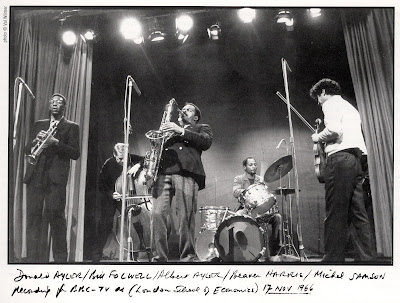
Like much music for me, there are points in this album where melodies or brief intonations must have become etched in my brain  in tandem with particular events or images from my life, forever linking the two.   The music  on this remarkable 2-disc set, recorded mostly in 1966 and 1967 (one track from 1965) became the backdrop for the summer of what was an exciting time in my life... preparation for a month-long adventure into the north woods of Upper Michigan which was to be followed by my marriage to the love of my life, the amazing women who continues to tolerate ( and sometimes even encourages) my many obsessions, including my passion for this strange music.   At times when I listen to the album, I return to a particular day in  summer 2005; a day I spent listening to this album while packing equipment and supplies in excited anticipation for the month-long UP adventure that my soon-to-be wife and I were about to embark on.  There are a few high-pitched scratches of Sampson's violin that even bring back the smell of that old apartment like it was yesterday, a strange musty smell intermixed with the old campfire smell of my camping gear.


Albert Ayler, Live in Greenwich Village: The Complete Impulse Recordings
Impulse, 1965, 1966, 1967 (1998 CD)
Albert Ayler: alto and tenor saxophone
Alan Silva: bass
Beaver Harris: drums
Bill Folwell: bass
Call Cobbs: piano
Donald Ayler: trumpet
George Stell: trombone
Henry Grimes: bass
Joel Freedman: cello
Lewis Worrell: bass
Michel Sampson: violin
Sunny Murray: drums

 "Live from Greenwich Village" is over two hours of rollicking marches, dirges, and triumphant wails recorded live in fantastic sound quality, as you would expect from a major label like Impulse.  For most of the pieces, a beautiful and unique foundation is laid down by the strings - the violin of Michel Sampson and/or the bass of Alan Silva, Bill Folwell, Henry Grimes, and/or Lewis Worrell.  Like Ayler's earlier work, most of these songs are structured around simple march-like themes, but the strings and Don's trumpet lead to a much denser sound.  The album starts at a pretty high intensity, with "Holy Ghost" and Albert freely improvising over what sounds to me like some sort of vocal droning (but perhaps something else?).  This is followed by a wonderful dirge-like march "Truth is Marching In."  The third track is truly spectacular, a deeply emotional piece called "Our Prayer" that was written by Don Ayler.  Don takes the melody on trumpet, with the violins building and releasing the intensity of the song throughout and Albert lending short punctuated cries on the sax.  Most critics have blasted Don for his lack of "technical skill," but the emotional power of this song and Don's ability to convey it are truly moving - I'll take this song over anything Wynton Marsalis has ever done.  "Spirits Rejoice" and "Divine Peacemaker" are both triumphant marches with extended, stratosphere-shaking free improvisations.  The final song on the first disc, "Angels" is a duo piece, Albert with Call Cobbs on piano - it is stunningly beautiful and it is fascinating to hear Albert in this kind of setting.  The second disc begins with "For John Coltrane," a moving and fitting tribute to the legacy of John Coltrane, who died in 1967.  The piece manages to be mournful and jubilant at the same time, and for me is a real highlight of the set - although picking highlights from this collection is difficult.  The remainder of the second disc is just as good as the first, continuing to use simple march-like themes as a springboard for improvisation and emotional exploration.  Tell your friends.  Play it for your enemies.

Thursday, January 22, 2009

Spiritual Unity

I’ll continue with the Albert Ayler theme that I started last time. “Love Cry” was my first real introduction to this crazy, life-affirming music. After a few weeks of having the disc on continuous rotation (much to my wife’s horror), I was ready to continue with my education. I read everything I could find about Albert Ayler, and quickly realized that “Spiritual Unity” was the album that many would consider his masterpiece. I ordered the disc directly from ESP, and waited patiently for its arrival.


Albert Ayler, Spiritual Unity
1964, ESP
Albert Ayler: Tenor saxophone
Gary Peacock: Bass
Sunny Murray: Percussion

On July 10th of 1964, Albert Ayler, Gary Peacock, and Sunny Murray walked into the tiny studio of the newly formed ESP label. The result was “Spiritual Unity” - a concise, confident, and beautifully crafted musical statement. Words can’t really do this album justice, the interaction among the musicians – Sunny Murray’s drumming and Gary Peacock’s bass in particular, is astounding. Murray doesn’t keep time in any traditional sense; his subtle drumming interacts and intertwines with Peacock’s bass and creates a subdued, undulating undercurrent for Ayler’s sax. Loose marching themes are played by Ayler, and you'd swear that you have heard these simple melodies before. The themes are stated and restated, then deconstructed, then torn to shreds, then left completely behind with screams of jagged improvisation... and then the themes are restated. The results are mesmerizing.

The recording engineer apparently fled the control booth during the recording to avoid the chaos. For reasons unknown, he also thought that the recording was a demo and recorded it in mono instead of stereo. I found this out after I had owned the album for several months, listening to the entire thing twice every day on my bus commute to work (it was exactly the right length), and I honestly never noticed that it wasn’t in stereo – which is amazing particularly since I was listening to it on headphones. The communication among the musicians is so spellbinding I didn't notice. Play it loud.

Click on the player below to hear a 5-minute long clip of Bernard Stollman, founder of the ESP label, speak about his first meeting with Albert Ayler and a description of the Spiritual Unity session. This clip is from a longer segment focused on Albert Ayler and his music that can be listened to at ESP's web site.


Buy it directly from ESP

Buy it from amazon